Darshil Parmar · 4h 31m · 21 lessons
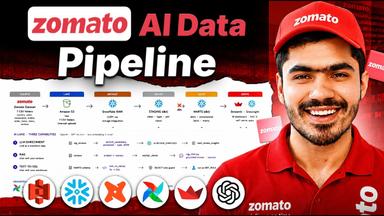
Zomato AI Data Analytics | End-To-End AI Data Engineering Project
Already know some of this? A 2-minute test skips the lessons you know.
Take the placement testThe plan
3 days at 90 min a dayDay 19 lessons · 1h 47mToday
- 1Project Overview & Business ProblemUnderstand the end-to-end AI data engineering project scope, the Zomato food delivery business context, and the high-level architecture covering S3, Snowflake, dbt, Airflow, and three AI layers.11m Notes and quiz
- 2Dataset Exploration & Data ModelExplore the seven CSV files (users, restaurants, orders, order_items, food, menu, reviews), their relationships via a star-schema data model, and the simulated data volumes (10M orders, 23M line items, 300k reviews).6m Notes and quiz
- 3Loading Raw Data to Amazon S3Create an S3 bucket with a raw/ folder structure, manually upload each CSV into its dedicated folder, and learn why manual upload is used for clarity versus scripting for large-scale data.11m Notes and quiz
- 4Snowflake Account Setup & Secure S3 IntegrationSign up for a Snowflake trial, create a storage integration with AWS IAM roles and external IDs for secure, credential-less access to the S3 bucket, and verify the trust relationship.24m Notes and quiz
- 5Defining File Formats & Stages in SnowflakeCreate a CSV file format with delimiter, header skip, and null handling, then define an external stage pointing to the S3 raw folder using the storage integration to list and access files.10m Notes and quiz
- 6Loading Raw Tables into Snowflake (Bronze Layer)Create raw schema tables with all columns as strings to preserve fidelity, then use COPY INTO with the stage and file format to bulk-load each CSV from S3 into Snowflake.11m Notes and quiz
- 7dbt Project Initialization & Profiles ConfigurationRun `dbt init` to scaffold the project, configure profiles.yml with Snowflake credentials, define sources.yml pointing to the raw schema, and understand dbt's role as a transformation orchestrator.14m Notes and quiz
- 8Building Staging Models (Silver Layer) with dbtWrite staging models (stg_restaurants, stg_users, stg_food, stg_menu, stg_orders, stg_order_items, stg_reviews) that clean data types, handle nulls, and join via `ref()` to create a dependency graph.13m Notes and quiz
- 9Medallion Architecture & Dimensional Modeling ConceptsContrast ELT vs ETL, explain the bronze/silver/gold layers, and review dimensional modeling fundamentals (fact tables, dimension tables, star schema) before building the gold layer.9m Notes and quiz