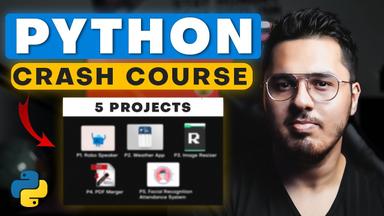
CodeWithHarry · 3h 09m · 23 lessons
Python Crash Course in Hindi | 5 Python Projects | Complete Python Tutorial
Already know some of this? A 2-minute test skips the lessons you know.
Take the placement testThe plan
2 days at 90 min a dayDay 114 lessons · 1h 42mToday
- 1Course Introduction and Python InstallationUnderstand the course structure, install Python from python.org, and learn why PyCharm is the recommended IDE.6m Notes and quiz
- 2Writing Your First Program and Using CommentsWrite and run a 'Hello World' program, then use single-line (#) and multi-line (''' ''') comments to document or disable code.6m Notes and quiz
- 3Variables and Basic Data TypesCreate variables to store integers, floats, booleans, strings, and None; understand dynamic typing and basic naming rules.9m Notes and quiz
- 4Arithmetic and Assignment OperatorsApply +, -, *, /, //, %, ** operators and compound assignment operators (+=, -=, *=, /=, //=, **=, %=) on numeric variables.5m Notes and quiz
- 5Comparison and Logical OperatorsUse ==, !=, >, <, >=, <= to compare values and and, or, not to build boolean logic for conditional statements.5m Notes and quiz
- 6Modules, Pip, and Virtual EnvironmentsInstall third-party packages with pip (e.g., pandas, openpyxl), import them with aliases, and explore useful libraries like sklearn and plyer.6m Notes and quiz
- 7Strings: Formatting, Slicing, and Common MethodsCreate strings with quotes and f-strings, slice them using indices, and apply methods like upper(), lower(), count(), replace(), and split().9m Notes and quiz
- 8User Input and Type ConversionCapture user input with input(), convert it to numbers using int() or float(), and handle the string-to-number conversion for calculations.7m Notes and quiz
- 9Lists: Creation, Mutability, and Core MethodsBuild mutable lists, modify them with append(), pop(), remove(), sort(), extend(), and query them with index(), count(), and slicing.8m Notes and quiz
- 10Tuples: Immutable SequencesCreate tuples with parentheses, access elements by index, use count() and index() methods, and understand immutability versus lists.4m Notes and quiz
- 11Sets: Unique Collections and Set OperationsCreate sets with curly braces, leverage uniqueness, and perform union, intersection, difference, and symmetric difference operations.6m Notes and quiz
- 12Dictionaries: Key-Value Storage and MethodsCreate dictionaries with key-value pairs, access and modify values, and use methods like get(), keys(), values(), items(), update(), and pop().10m Notes and quiz
- 13Conditional Logic with if-elif-elseWrite conditional blocks using if, elif, else, comparison operators, and logical operators to control program flow based on user input.13m Notes and quiz
- 14While Loops and Loop ControlBuild condition-controlled loops with while, create intentional infinite loops with break conditions, and apply break/continue in both loop types.6m Notes and quiz