MLSquare · 1h 47m · 12 lessons
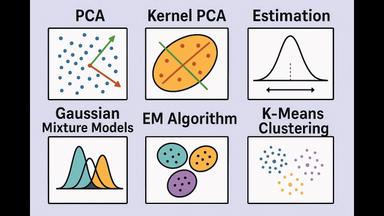
PCA | Kernel PCA | Estimation | Gaussian Mixture Models | EM Algorithm | K-Means Clustering
Already know some of this? A 2-minute test skips the lessons you know.
Take the placement testThe plan
1 day at 90 min a dayDay 112 lessons · 1h 47mToday
- 1PCA: Prerequisites and Linear Algebra FoundationsReview the linear algebra prerequisites for PCA including covariance matrix construction, eigenvalue/eigenvector properties, trace and determinant relationships, and eigendecomposition computation.13m Notes and quiz
- 2PCA: Objective, Reconstruction Error, and Algorithm StepsUnderstand the PCA objective of minimizing reconstruction error, its equivalence to maximizing variance, and the step-by-step algorithm: center data, compute covariance matrix, find top K eigenvectors as principal components.13m Notes and quiz
- 3Kernel PCA: Motivation and Kernel Matrix ConstructionLearn why Kernel PCA captures nonlinear relations by mapping to a higher-dimensional space, and how the kernel matrix K = ΦᵀΦ relates to the kernel function k(xᵢ, xⱼ) = φ(xᵢ)ᵀφ(xⱼ).9m Notes and quiz
- 4Kernel PCA: Centering, Valid Kernels, and Popular ChoicesUnderstand kernel matrix centering (Kc = K - 1ₙK - K1ₙ + 1ₙK1ₙ), the criteria for valid kernels (symmetric, positive semidefinite), and popular kernels: polynomial (xᵢᵀxⱼ + c)ᵖ and RBF exp(-||xᵢ-xⱼ||²/2σ²).10m Notes and quiz
- 5Kernel PCA: Eigendecomposition and New Point ProjectionCompute principal components in Kernel PCA via eigendecomposition of the centered kernel matrix Kc, and project new data points using kernel evaluations without explicitly computing φ.10m Notes and quiz
- 6Estimation: Maximum Likelihood Estimation (MLE)Apply MLE by writing the likelihood function, taking the log, differentiating to find critical points, and verifying maxima with the second derivative test.10m Notes and quiz
- 7Estimation: Bayesian Estimation with Conjugate PriorsPerform Bayesian estimation by combining prior and likelihood to obtain the posterior, leveraging conjugate priors (e.g., Beta-Binomial) for closed-form posterior computation.5m Notes and quiz
- 8Gaussian Mixture Models: Definition and Parameter CountingDefine GMMs as mixtures of K Gaussians with parameters πₖ, μₖ, Σₖ, and compute the number of free parameters (3K-1 for 1D with shared variance).5m Notes and quiz
- 9EM Algorithm for GMM: E-step and M-step DerivationDerive the EM algorithm for GMM: E-step computes responsibilities γ(zᵢₖ) = πₖN(xᵢ|μₖ,Σₖ)/ΣⱼπⱼN(xᵢ|μⱼ,Σⱼ); M-step updates πₖ, μₖ, Σₖ using weighted averages.10m Notes and quiz
- 10EM Algorithm for GMM: Worked ExampleSolve a concrete GMM/EM problem: compute P(component=1 | x₁=1) with given π, μ, σ², simplifying using cancellations to obtain 1/(1+e⁻²).5m Notes and quiz
- 11K-Means Clustering: Lloyd's Algorithm and Objective FunctionUnderstand K-means as iterative minimization of within-cluster sum-of-squares: initialize assignments, recompute centroids as means, reassign points to nearest centroid, repeat until convergence to a local optimum.10m Notes and quiz
- 12K-Means++: Smart Initialization for K-MeansApply K-means++ initialization: pick first centroid uniformly at random, then choose subsequent centroids with probability proportional to squared distance from nearest existing centroid.7m Notes and quiz