Zachary Huang · 1h 16m · 11 lessons
Give Me 1 Hour, I'll Make Deep Learning Click Forever
Already know some of this? A 2-minute test skips the lessons you know.
Take the placement testThe plan
1 day at 90 min a dayDay 111 lessons · 1h 16mToday
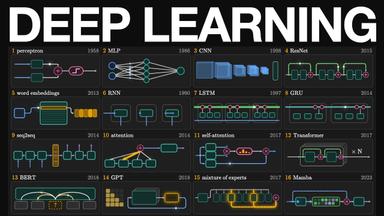
- 1Perceptron: One Neuron, One Linear BoundaryExplain how a single perceptron learns a linear decision boundary using weighted sums and a step activation, and why it cannot solve non-linearly separable problems like XOR.13m Notes and quiz
- 2CNN: Convolution & Weight Sharing for ImagesExplain how convolutional layers use small, shared filters to detect patterns (edges, textures) anywhere in an image with far fewer parameters than an MLP, and how ReLU and pooling build hierarchical feature maps.6m Notes and quiz
- 3ResNet: Skip Connections Solve the Degradation ProblemExplain why stacking more CNN layers hurts performance (degradation/vanishing gradients) and how ResNet's residual blocks with identity skip connections make deep networks easy to train.10m Notes and quiz
- 4RNN: Sequential Reading with a Hidden StateExplain how a Recurrent Neural Network processes tokens one by one while updating a fixed-size hidden state, allowing it to handle variable-length sequences but suffering from vanishing gradients over long distances.4m Notes and quiz
- 5LSTM & GRU: Gated Memory for Long-Range DependenciesContrast LSTM's separate long-term/short-term memory with GRU's merged gated memory, and explain how both preserve gradients across many time steps to capture long-range context.6m Notes and quiz
- 6Seq2Seq & Attention: Encoder-Decoder with Soft AlignmentDescribe the encoder-decoder architecture for sequence-to-sequence tasks, the bottleneck of a single context vector, and how attention lets the decoder weigh all encoder states at each step.8m Notes and quiz
- 7Self-Attention & Transformer: Parallel Processing with PositionExplain how self-attention lets every token attend to all others in parallel, why positional encodings are required to preserve order, and how the Transformer block stacks attention, MLP, skips, and LayerNorm.8m Notes and quiz
- 8BERT: Bidirectional Encoder for UnderstandingDescribe BERT's encoder-only Transformer, masked language model pre-training, and how the [CLS] token enables fine-tuning for classification, QA, and NER with minimal labeled data.7m Notes and quiz
- 9GPT: Decoder-Only Generative Pre-trainingContrast GPT's causal (look-back only) self-attention with BERT's bidirectional attention, and explain how next-token prediction on massive text enables zero-shot/few-shot task generalization via prompting.5m Notes and quiz
- 10Mixture of Experts: Sparse Scaling with a Learned RouterExplain how Mixture of Experts replaces the dense feed-forward MLP with multiple expert MLPs and a router that activates only a subset per token, increasing capacity while keeping compute constant.4m Notes and quiz
- 11Mamba: Fixed-Size State for Efficient Long ContextDescribe how Mamba (State Space Model) uses a selection mechanism and convolution-like recurrence to maintain a fixed-size memory, enabling linear-time scaling with sequence length and parallel training.5m Notes and quiz