Already know some of this? A 2-minute test skips the lessons you know.
Take the placement testA free 23-lesson course built from DSwithBappy's 4h 23m of YouTube video. 3 days at 90 minutes a day, with study notes and a quiz in every lesson. A 2-minute placement test skips what you already know.
Taught by DSwithBappy on YouTube. Videos play in YouTube's own player, so the creator keeps every view.
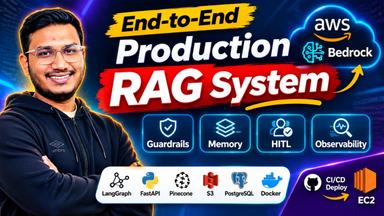
Understand the end-to-end production RAG system Atlas Enterprise AI, its features (document upload, chat, guardrails, HITL, memory, observability), and see a complete live demo of the application.
Define the enterprise knowledge retrieval problem, review the proposed Atlas AI solution architecture, and identify the full technology stack (FastAPI, LangGraph, AWS Bedrock/S3/EC2/ECR, Pinecone, PostgreSQL on Render, GlassFlow Rias).
Provision and configure all cloud services: create an IAM user with least-privilege permissions, enable Bedrock models (Titan embeddings, Nova Lite chat), create an S3 bucket with CORS, spin up a free Pinecone index, deploy a PostgreSQL instance on Render, and generate a Rias API key for observability.
Set up the local Python environment, create a reusable project-structure generator script, write the `.env` and centralized `config.py` (with LRU-cached service clients), define the PostgreSQL schema (documents, chat_messages, approvals, feedback, audit_events) in `schema.sql`, and run `init_db.py` to create all tables on Render.
Implement `aws.py` with LRU-cached `get_aws_client`, `get_embedding`, and `get_chat_response` helpers, then verify Bedrock Titan embeddings (1024-dim) and Nova Lite chat completion with a standalone test script.
Build `ingest.py` to download PDFs from pre-signed S3 URLs, extract text with `pypdf`, chunk with recursive character splitting, embed via Bedrock Titan, and upsert vectors into Pinecone while updating document status in PostgreSQL.
Create `guardrails.py` with compiled regex patterns to detect prompt injection, secret leakage, and sensitive-output risks; expose `check_input` and `check_output` functions that raise `InputGuardrailBlocked` / `OutputGuardrailBlocked` exceptions.
Assemble `graph.py`: define a typed `State`, add nodes for input guard, Pinecone retrieval, evidence router, no-evidence fallback, answer generation, output guard, and compile the graph; wrap invocation in `chat.py` for clean imports.
Implement `memory.py` with `load_history`, `save_message`, and `list_messages` helpers that read/write the `chat_messages` table keyed by `conversation_id` to provide multi-turn context to the RAG graph.
Instrument every LangGraph node and external call (Bedrock, Pinecone, PostgreSQL) with `@trace` decorators sending spans to Rias; verify traces appear in the dashboard with latency, token counts, and error flags.
Write `main.py` with endpoints for document upload (pre-signed S3 URL), ingestion trigger, chat (invokes RAG graph), approval queue (HITL), metrics, and document listing; serve a single-page HTML/CSS/JS dashboard (`index.html`, `style.css`, `app.js`) that consumes these APIs.