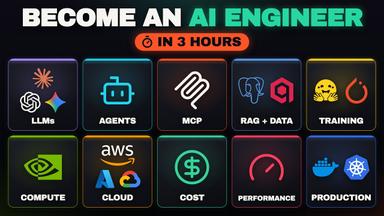
Cloud X Berry · 2h 54m · 30 lessons
AI Engineer Full Course in 3 Hours [FREE]
Already know some of this? A 2-minute test skips the lessons you know.
Take the placement testThe plan
2 days at 90 min a dayDay 117 lessons · 1h 44mToday
- 1Course Introduction: From Answering to DoingUnderstand the scope of the course: moving beyond chatbots to agents that act, use tools, remember, and connect to live systems, and recognize the engineering layers that make production AI systems reliable.17m Notes and quiz
- 2The Context Window as a Budget: The 'Lost in the Middle' ProblemTreat the context window as a limited working budget, not a storage bin, by positioning key information at the edges, summarizing or dropping old tool results, and retrieving only the best chunks to avoid the U-shaped attention drop in the middle.4m Notes and quiz
- 3Tool Calling: How an Agent Does SomethingTrace a tool call from model proposal through the control loop's validation, permission checks, idempotency keys, error handling, and trace logging, and explain why a small set of well-described tools beats a long list.7m Notes and quiz
- 4MCP (Model Context Protocol): A Standard Way for Agents to Reach ToolsDescribe how MCP servers expose tools, resources, and prompts in a standard schema so many AI apps can share them, and distinguish connection (MCP) from authorization (gateway and code-enforced limits).5m Notes and quiz
- 5MCP vs. Agent Skills: Two Different Answers to the Same ProblemContrast MCP (standardized access to external systems) with Skills (procedural know-how that loads on demand), and recognize that hard business limits still belong in code, not in the model or prompt.5m Notes and quiz
- 6Agent Roles and Boundaries: Why Multi-Agent Systems Need Clear OwnershipDefine clear roles, permissions, and handoff protocols for each agent in a multi-agent system so that work is owned, checked, and traceable, and avoid central bottlenecks or context loss in peer-to-peer setups.5m Notes and quiz
- 7The AI Gateway: A Different Front Door for AI Traffic Than a Website NeedsExplain how an AI gateway differs from a standard API gateway by checking identity and budget, routing to the right model, enforcing token caps, caching reusable prompt prefixes, and keeping a costed trace for every model call.5m Notes and quiz
- 8Beyond Basic RAG: Why Simple Retrieval Stops WorkingDiagnose the six silent failure modes of basic RAG (chunking splits, semantic near-misses, exact-term misses, vague queries, context overload, stale data) and trace a wrong answer back through the retrieval pipeline instead of blaming the model.7m Notes and quiz
- 9A Field Guide to RAG Variants: When Simple, Self-Correcting, or Agentic RAG ApplMatch each RAG upgrade family (hybrid search, reranking, query rewriting, evidence checking) to the specific retrieval failure it fixes, and evaluate the added latency, cost, and failure risk before stacking them.5m Notes and quiz
- 10Knowledge Graphs vs. GraphRAG vs. Graph Engineering: Three Different JobsSeparate the knowledge graph (explicit relationship store), GraphRAG (retrieval planner that follows links), and graph engineering (building and maintaining the graph), and debug wrong answers by checking data layer, retrieval layer, then decision layer in that order.6m Notes and quiz
- 11Agentic RAG: When Retrieval Becomes a Decision Instead of a StepDescribe how agentic RAG turns search into tools the agent chooses at runtime, and explain the trade-offs: more adaptive search paths versus added model calls, context growth, and the need for step budgets in the gateway.5m Notes and quiz
- 12Building a Living Knowledge Base Instead of a Notes GraveyardImplement ingestion with versioning and replacement marking, assign owners and review dates to every document, use traces to catch silent sync failures, and add regression cases to the golden eval set so policy drift is caught automatically.6m Notes and quiz
- 13Data Architecture for AI: Pipelines, Versioning, and Keeping Training Data HonesApply software-engineering rigor to training data: clean sources, separate test sets, version every dataset, and maintain lineage from each model back to the data that produced it so bad behavior can be traced to its root.8m Notes and quiz
- 14From Early Neural Networks to Transformers: Why Today's Models Look This WayTrace the architectural evolution from CNNs and RNNs to the Transformer, explaining how self-attention enables parallel training on massive context and why that shapes every model engineers work with today.6m Notes and quiz
- 15Changing a Model: Knowledge, Behavior, or Size?Climb the ladder of cheaper fixes (clearer prompts, retrieval, few-shot examples) before fine-tuning, and distinguish knowledge changes (retrieval's job), behavior changes (supervised fine-tuning), and size/cost changes (distillation, compression, routing).5m Notes and quiz
- 16LoRA: How Teams Fine-Tune Without Retraining EverythingExplain how LoRA freezes the base model and trains a low-rank add-on to shift behavior cheaply, choose rank and learning rate based on evals not defaults, and version each add-on with its dataset and pass/fail gates.5m Notes and quiz
- 17Distillation: Teaching a Small Model to Act Like a Big OneDescribe distillation (student imitates teacher's full output distribution), its trade-offs (inherits teacher's blind spots, narrow competence), and the need to test on the full real distribution and respect provider terms on output usage.5m Notes and quiz