Already know some of this? A 2-minute test skips the lessons you know.
Take the placement testA free 33-lesson course built from Saifullah Ajaz 's 4h 32m of YouTube playlist. 3 days at 90 minutes a day, with study notes and a quiz in every lesson. A 2-minute placement test skips what you already know.
Taught by Saifullah Ajaz on YouTube. Videos play in YouTube's own player, so the creator keeps every view.
Explain how employment laws covering recruitment, contracts, health & safety, minimum wages, and trade unions impact business costs and worker motivation.
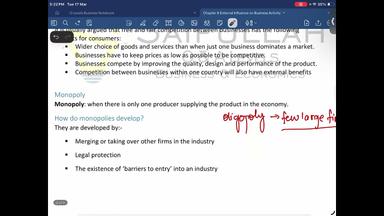
Explain how government legislation promotes competition, controls monopolies/oligopolies, and assess the impact of market structure on consumers and business efficiency.
Assess the impact of environmental legislation and pressure groups on business costs, brand image, and operational strategy.
Evaluate the arguments for and against privatisation, including efficiency gains, monopoly risks, and effects on essential services.
Identify the six main government economic objectives and explain how the business cycle (growth, boom, recession, slump, recovery) impacts business activity.
Distinguish between cost-push and demand-pull inflation, evaluate the advantages and disadvantages of inflation for businesses, and explain why deflation can harm profitability and investment.
Classify cyclical, structural, and frictional unemployment; interpret balance of payments deficits/surpluses; and assess how exchange rate appreciation and depreciation affect importers and exporters.
Explain how expansionary and contractionary fiscal policy (taxes, spending) and monetary policy (interest rates, money supply) influence business costs, investment, consumer demand, and international competitiveness.
Understand the concept of strategic choice and how the Ansoff Matrix analyses four growth strategies (market penetration, product development, market development, diversification) by assessing product and market risk.
Apply Force Field Analysis to a strategic decision by identifying driving and restraining forces, assigning subjective weightings, and calculating net force to determine viability.
Construct and interpret decision trees using decision nodes, chance nodes, probabilities, and economic returns to calculate expected values for alternative choices.
Critique decision trees for enabling quantitative risk analysis and logical discussion, while highlighting reliance on accurate data, subjective probability estimates, and the limitation of expected values representing average rather than certain outcomes.
Understand the purpose of strategic analysis as the starting point for strategy formulation and apply SWOT analysis to identify internal strengths/weaknesses and external opportunities/threats.
Evaluate the benefits of SWOT for strategy assessment and competitive advantage, and recognize its limitations regarding subjectivity, lack of quantification, and insufficiency as a standalone tool.
Conduct a PEST analysis to assess Political, Economic, Social, and Technological macro-environmental factors and understand its complementary relationship with SWOT.
Analyze industry competitiveness using Porter's Five Forces, specifically evaluating barriers to entry and the bargaining power of buyers.
Complete the Porter's Five Forces framework by analyzing supplier power, threat of substitutes, and competitive rivalry to determine overall industry attractiveness.
Define business strategy as an action plan to achieve objectives and explain the three stages of strategic management: analysis, choice, and implementation.
Distinguish between corporate strategy, business (divisional/product) strategy, and tactics, and show how they link to the hierarchy of objectives.
Compare Red Ocean (competing in existing markets) and Blue Ocean (creating new uncontested markets) strategies using examples like Netflix and DVD rentals.
Apply the Eliminate-Reduce-Raise-Create framework to design a Blue Ocean strategy that makes competition irrelevant.
Explain scenario planning as an approach to strategy, illustrate with cricket power-play/middle-overs/death-overs scenarios, and outline its advantages for flexible decision-making.
Evaluate the drawbacks of scenario planning including manager confusion from too many scenarios, short-term focus, and inability to predict long-term 'black swan' events.
Understand the three stages of strategic management (analysis, choice, implementation) and the components of a corporate plan (objectives, strategies, departmental objectives).
Explain how corporate planning provides clear direction, improves communication, enables performance control and review, and identifies strengths and weaknesses.
Analyze the drawbacks of corporate planning including inflexibility, time and cost constraints, and vulnerability to external uncertainty.
Distinguish between power, role, task, and person cultures using Handy's model and apply them to organizational examples like hospitals and tech firms.
Describe entrepreneurial culture and explain why corporate culture changes due to business failure, market shifts, ownership changes, or takeovers.
Recaps strategic management stages and explains why corporate culture must change during strategy implementation, covering triggers like business failure, market shifts, and ownership changes.
Contrasts leading change (inspiring acceptance) with managing change (resource allocation), emphasizing the leader's role in overcoming resistance and ensuring organization-wide buy-in.
Analyzes four key reasons for resistance—fear of the unknown, fear of failure, loss of value, and inertia—with practical workplace examples for each.
Explains the contingency planning cycle (identify disaster, assess likelihood, minimize impact, plan recovery), its advantages for stakeholder confidence, and its drawbacks versus prevention-focused quality management.