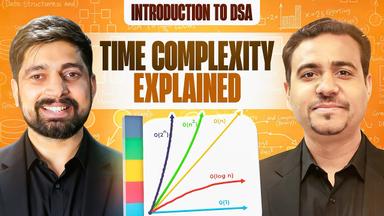
Chai aur Code · 1h 17m · 9 lessons
1. Introduction to DSA and Time Complexity in Python
Already know some of this? A 2-minute test skips the lessons you know.
Take the placement testThe plan
1 day at 90 min a dayDay 19 lessons · 1h 17mToday
- 1Data, Data Structures, and Algorithms ExplainedDefine data, explain the need for data structures (linear and non-linear) to organize information in memory, and define algorithms as a set of instructions to process data.13m Notes and quiz
- 2Dominant Terms and Growth Rate HierarchyLearn the hierarchy of function growth rates (1 < log log n < log n < n < n² < 2ⁿ) and how to identify the dominant term in an equation to determine time complexity.6m Notes and quiz
- 3Mathematical Foundations: Constant, Linear, Quadratic, and Logarithmic FunctionsIdentify constant, linear, quadratic, cubic, logarithmic, and exponential mathematical functions and determine their dominant terms for complexity analysis.7m Notes and quiz
- 4Asymptotic Notations: Best, Average, and Worst Case AnalysisDifferentiate between Big-O (worst case), Omega (best case), and Theta (average case) notations and understand why worst-case analysis is the standard default.11m Notes and quiz
- 5Linear Time Complexity O(n) and Sequential LoopsAnalyze single loops iterating proportionally to n, understand how sequential loops add complexities (n + n = O(n)), and ignore constant multipliers.7m Notes and quiz
- 6Quadratic Time Complexity O(n²) from Nested LoopsDetermine quadratic time complexity O(n²) resulting from nested loops where iterations multiply (n * n), and learn to pick the dominant term in mixed code.7m Notes and quiz
- 7Cubic Time Complexity O(n³) and Conditional ComplexityExtend nested loop analysis to three levels for O(n³) complexity and evaluate time complexity of if/else blocks by selecting the worst-case branch.8m Notes and quiz
- 8Logarithmic Time Complexity O(log n) from Dividing LoopsDerive O(log n) complexity for loops where the loop variable is divided by a constant (e.g., n = n/2) each iteration, using mathematical logarithmic properties.9m Notes and quiz
- 9Logarithmic Complexity Variations and Course ChallengeConfirm that dividing by any constant yields O(log n), recognize reverse logarithmic growth (multiplying by constant), and apply the '30-second rule' to analyze a mixed-complexity program.10m Notes and quiz